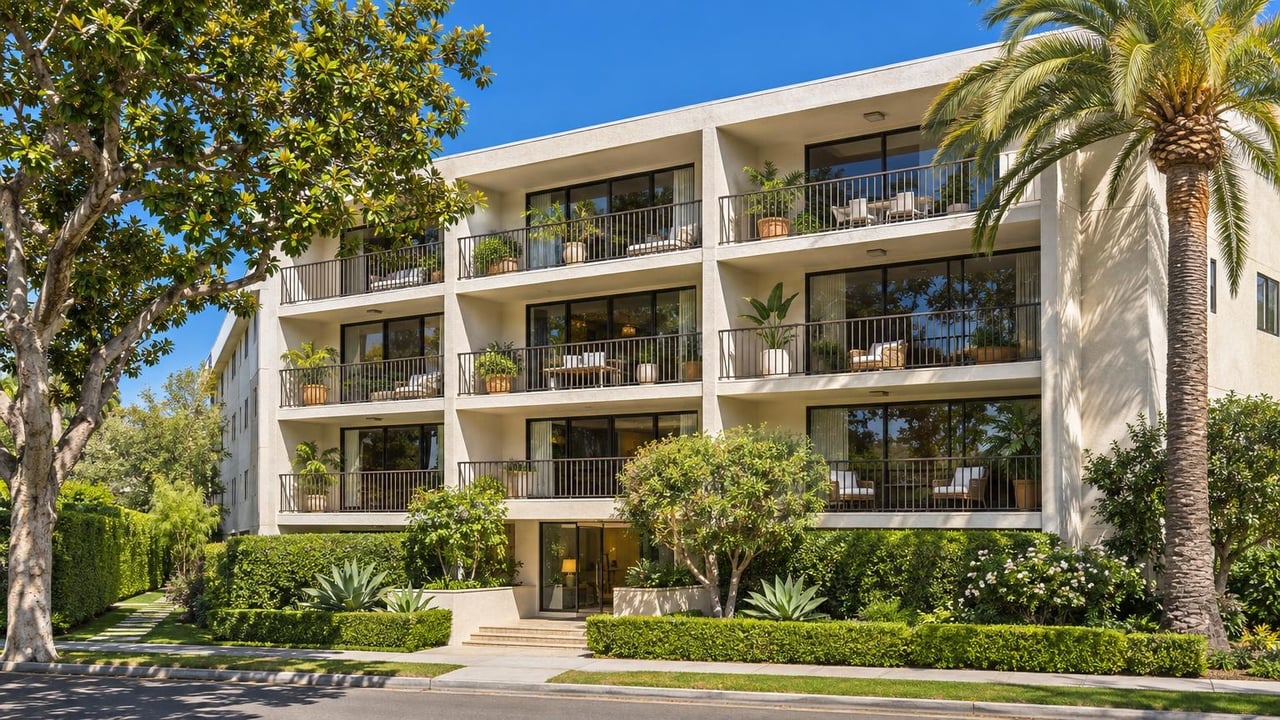
Start on the 300 block of South Rexford Drive. Most of the apartment buildings there went up between 1953 and 1957, after many of the original houses on the block were torn down or moved. One of them is an eight-unit building at 328 South Rexford, designed in 1956 by architect-builder Jules G. Salkin, and it stands where a house used to be. About a mile west in Century City, The Century is a 42-story tower with 140 residences, a four-acre garden, a lap pool and a screening room. It was finished in 2010.
The two neighborhoods share a border, and many condo buyers tour both in the same weekend. The buildings they walk through come from two different plans, made decades apart for different purposes. The Beverly Hills condo stock is tied to a set of small-lot apartment streets laid out generations ago, and the newest projects approved on those streets are listed as rentals. Century City was designed around towers. When you compare listings across the line, the first thing you are comparing is the kind of building, and the address comes second.
Beverly Hills drew its apartment streets early
The Rodeo Land and Water Company's 1906 plan, drawn by Wilbur F. Cook Jr., graded the town from smaller lots along its southern edge up to large estates in the north. Beverly Hills incorporated in 1914 and annexed the land south of Wilshire in 1915. In the 1920s and 1930s, the area south of Wilshire and Santa Monica boulevards filled with duplexes, fourplexes and central-hall apartment buildings, mostly in Period Revival or Moderne styles, and Spanish Colonial Revival was especially popular in the 1920s. That history comes from the city's 2004 historic survey.
The 2004 survey names those streets. The Tract 7710 area, south of Wilshire and north of Olympic, takes in Robbins, Young, South Lasky, South Spalding, Linden, McCarty, Roxbury, Bedford, Peck and Camden. Most of it was built in the 1930s as two-story duplexes, fourplexes and six- to eight-unit buildings in French Eclectic, Spanish Colonial, Monterey and Tudor Revival styles. The Beverly Vista area is a narrow band between Wilshire and Charleville, along the South 100 blocks of Reeves, Canon, Crescent, Elm, Rexford, Maple and Palm. The survey also maps a multifamily district on the 400 blocks of South Roxbury and South Bedford, from the late 1920s and early 1930s, and another along Olympic from South Rexford to Shirley Place, mostly from the 1930s.
The apartment land grew slowly, so the city also rebuilt in place
The city's 1977 Land Use Element tracks multifamily land across the postwar years. It grew from 192.7 acres in 1947 to 229.6 acres in 1974, a 19.1% increase, while its share of the city's land moved only from 7.9% to 8.3%. By then, most of the vacant multifamily land left was in the Maple–Oakhurst–Third area.
With little new land to build on, the district also got denser. According to the city's historic context, apartment buildings changed around 1950 from period-style fourplexes to modernist "stucco box" buildings. By the 1960s they were larger, often built across several combined parcels, with underground parking. On South Rexford and South Elm, the city's 2016 landmark assessment links that 1950s wave partly to expanded federal financing and incentives for small investment companies. Salkin's buildings at 328 South Rexford (1956) and 360 South Elm (1955) are two examples.
So when you shop Beverly Hills condos, you are mostly shopping buildings from those rounds of construction, on lots that were laid out for something smaller. A 1930s fourplex and a 1960s building over parcels joined across two or three lots can sit side by side on the same block. They differ in parking, unit layout and how much shared space they have.
Those older buildings are also on the city's preservation radar. The city's December 2023 multifamily survey looked at about 1,400 multifamily properties and found 392 potentially eligible for historic recognition. It also identified 11 potential multifamily districts, three of them new: Beverly Green, South Arnaz Drive and La Peer-Swall-Clark. Those findings are survey results, not landmark designations. They do show that the city regards these streets as part of its architectural record.
The newest approvals on those streets are rental
The city's 2025 Housing Element progress report lists the three most recent replacement projects on these blocks with renter tenure. In October 2025, Urbanize LA reported that the Planning Commission approved two Builder's Remedy projects designed by Ottinger Architects. One is a 12-story, 65-unit building at 346 North Maple Drive with 13 affordable units. The other is an 11-story building at 401 North Oakhurst Drive with 25 two-bedroom apartments. The Beverly Press reported that the Maple project replaces an eight-unit apartment building from 1947 and the Oakhurst project replaces a six-unit building from 1937.
On Durant Drive, a six-story, 29-unit apartment building designed by LOHA, with three very-low-income units, went through a state density-bonus approval. The city's Architectural and Design Review Commission approved its design 3–1 on March 18, 2026, the Beverly Hills Courier reported.
All three are listed as rental projects that replace older apartment buildings with taller ones. The same is true of the larger towers covered in our post on why so few of Beverly Hills' new towers are condos. For a condo buyer, that means the Beverly Hills resale stock will keep its current character for years. New construction will change the skyline around your building, but it won't give you more condos to choose from.
Century City was planned around towers from the start
Century City began as a land deal. According to a City of Los Angeles planning report, 20th Century Fox announced a $400 million hotel, apartment and office community on its lot in January 1958. In May 1959 it handed title to William Zeckendorf's company for about $43 million and kept a long-term lease on roughly 75 acres for the studio. By late 1961, Welton Becket and Associates had revised the master plan for Alcoa, which had joined the project. The revision raised density and put residential high-rises in the southeast quadrant. The first twin residential towers, designed by I.M. Pei with Welton Becket, came after the first gateway office buildings were finished in 1963 and 1964.
The Century City Chamber of Commerce history says the plan set aside 75 acres for housing and 85 for business. Not all of that housing is high-rise. The Los Angeles Times described Century Woods as a gated 1980s community with 48 condos and 32 detached homes. Even so, the district's identity comes from its towers. When The Century was completed, the Times listed its 24-hour concierge, wine storage, banquet rooms, fitness center and library.
Staff and shared spaces on that scale are paid for through the association, so a tower buyer is comparing service levels as much as square footage. Ask for the current budget on any unit you consider, and confirm costs with the right professional, since this post is general information and not legal, tax or financial advice.
How to compare listings across the line
Average figures blend these two kinds of building. For the second quarter of 2026, The Real Deal reported brokerage research counting 147 condo deals in the combined Westwood/Century City submarket, with an average sale price of about $1.5 million and about $838 per square foot. That number mixes Century City's towers with Westwood's own stock. A per-foot figure like that tells you little about a 1960s building on South Elm. A Beverly Hills listing compares more fairly with other buildings from the same era on nearby streets than with a tower a mile away.
The wider market has been slow for condos. In January and February 2026, 1,976 condos sold in Los Angeles County, the weakest start to a year since Attom began tracking in 2005. The county condo median in February 2026 was down 4.5% from a year earlier. USC's Richard Green told the Los Angeles Times that "condos usually go softer faster than single-family homes" when the housing market cools. In a slow market, you have time to compare building types carefully.
| What you're comparing | Beverly Hills condo | Century City condo |
|---|---|---|
| Where the stock comes from | Apartment districts on small lots, mostly from the 1920s–30s and the 1950s–60s | A 1960s master plan for the former Fox lot, with towers in the southeast quadrant |
| Typical scale | Fourplexes up to mid-rise buildings on combined parcels | High-rise towers, plus gated low-rise communities like Century Woods |
| What's being added nearby | Rental buildings on North Maple, North Oakhurst and Durant | Fox's lot plans and a subway station |
| Transit timing | D Line already at Wilshire/La Cienega | Century City/Constellation station forecast for spring 2027 |
Both neighborhoods are tied to the Metro D Line extension. Metro's November 18, 2026 community presentation forecasts the Century City/Constellation station opening in spring 2027, subject to change. Beverly Hills' eastern edge already has its stop, as we covered in our subway post. On the studio side, The Real Deal reported in November 2025 that Fox's $1.5 billion Fox Future plan would add nine soundstages and more than 2 million square feet of production space, offices and parking. At that point the plan was still in environmental review.
Closing costs also differ, because Century City is inside the City of Los Angeles and Beverly Hills is a separate city. Our post on how the city line affects the tax on a high-end sale covers what that has meant in 2026.
Quick answers
Are new condos being built on Beverly Hills' apartment streets? The city lists the projects approved on North Maple, North Oakhurst and Durant as rentals. New for-sale condos in Beverly Hills are concentrated in a few branded developments at the top of the market.
Is a Beverly Hills condo building likely to be historic? The city's 2023 survey found 392 of roughly 1,400 multifamily properties potentially eligible for recognition. That is a survey finding, not a designation, so check the record for the specific building you're considering.
When does the Century City subway station open? Metro's November 2026 forecast puts the Century City/Constellation station in spring 2027, subject to change.
If you're deciding between a Beverly Hills building from the 1950s and a Century City tower, reach out to Danny Hizami and we can talk through how the two compare for what you need. Start Your Home Search and let's look at the buildings themselves.